Monday, March 3, 2014
New acquisition: colonial writ of execution
This document comes out of a contract dispute between shipwright Henry Smeath (or Smith) and Thomas Doughty, both of Saco, Massachusetts [now Maine]. Apparently, Mr. Smeath purchased an oak plank from Doughty in 1689 and refused to pay. In October of 1690, Doughty obtained a judgment in Suffolk County against Smeath in the amount of 14 pounds, 11 shillings, and six pence, to which is here added a 2 shilling fine for the cost of executing this court order.
Here, we have a writ of execution, signed by Joseph Webb, clerk of the Suffolk County court from 1690-1698. Webb ordered the Marshall General or his lawful deputy to find Smeath and obtain satisfaction of the judgment; otherwise, Smeath should be seized and committed to the safekeeping of the Boston prison keeper. I'm always curious about the people behind these documents. Did Smeath simply refuse to pay in protest of the judgment? Did he simply not have the money? Did he ultimately pay up, or was he arrested? Today, there would be an attachment of his assets; at this time in England and the colonies, there were debtors' prisons for those who couldn't or wouldn't meet their financial obligations.
Many thanks to the great folks at the Philadelphia Rare Books and Manuscripts Company for the excellent description of the item, from which this post is adapted. The detail about the oak plank is from the Genealogical Dictionary of Maine and New Hampshire.
Here, we have a writ of execution, signed by Joseph Webb, clerk of the Suffolk County court from 1690-1698. Webb ordered the Marshall General or his lawful deputy to find Smeath and obtain satisfaction of the judgment; otherwise, Smeath should be seized and committed to the safekeeping of the Boston prison keeper. I'm always curious about the people behind these documents. Did Smeath simply refuse to pay in protest of the judgment? Did he simply not have the money? Did he ultimately pay up, or was he arrested? Today, there would be an attachment of his assets; at this time in England and the colonies, there were debtors' prisons for those who couldn't or wouldn't meet their financial obligations.
Many thanks to the great folks at the Philadelphia Rare Books and Manuscripts Company for the excellent description of the item, from which this post is adapted. The detail about the oak plank is from the Genealogical Dictionary of Maine and New Hampshire.
Thursday, February 20, 2014
Panel--Francis Bacon: How a Renaissance Man Affects the Study of Everything
Mark your calendars for Wednesday, February 26th
at 4:00 p.m. in East Wing 120 for a panel discussion called "Francis Bacon:
How a Renaissance Man Affects the Study of Everything." Professor Daniel
Coquillette has gathered an impressive group of scholars from across the
university to discuss how Bacon still exerts influence on their various
disciplines (English, Biology, Chemistry, Political Science, and History;
Professor Coquillette will discuss Bacon’s impact on law). It’s an
exciting opportunity to bring different parts of the university together and to
discuss the legacy of this fascinating individual. The event is sponsored
by the Clough Center for the Study of Constitutional Democracy and the Boston
College Law Library; the panel is free and open to the public. We look forward to seeing you there. In the
meantime, please be sure to take a look at the exhibit on Bacon in Rare Book Room—it will only be on display for a few more weeks!
The portrait shown above is on loan to the Boston College Law Library from 2004 BC Law alumnus, Jeremy Evans. Jeremy has kindly loaned us this 17th century oil painting of Bacon, artist unknown. It has been in his family for generations, and we're honored that he has entrusted us with it for the exhibit and event. I cannot locate this particular portrait in any databases that I have access to; I've reached out to the National Portrait Gallery in London for their insights and hope to benefit from their expertise. If anyone has ideas about the details of this portrait (date, artist, original or copy, etc.), I'd love to hear them!
Friday, February 14, 2014
Happy Valentine's Day!
This is another favorite from Professor Michael H. Hoeflich's recent gift of his legal postcard and ephemera collection. These were the subject
of his book, The Law in Postcards and Ephemera, 1890-1962 (Clark,
NJ: Lawbook Exchange, 2012). The book contains hundreds of images of
ephemeral items that provide a glimpse into how the public
viewed the law and lawyers. Many of the cards portray children dressed
up as lawyers and judges.
This little valentine was produced by the George S. Carrington Greeting Card Company in Chicago. It seems like the little girl with the doll is pleading with the judge to consider fairly her Valentine's request!
Friday, February 7, 2014
Law student commonplace book
This is one of my favorite new acquisitions: a law student's notebook in the form of a commonplace book from around 1690. Commonplacing was a typical method of learning the law in England and in the American colonies and early United States. A student would follow the alphabetical arrangement of topics from an existing abridgement such as Brook's. A usual starting point would be abatement, and the student would provide brief descriptions of important cases on the topic; he would continue through the alphabet (if industrious) and finish with something like wards, warranties, or writs. About a third of the leaves in this commonplace are filled out, some quite copiously done; others, like the entry for "judges", are completely blank.
The student who compiled this notebook was Thomas Hanbury, who studied law in England around 1690 during the reign of William and Mary. As I mentioned during a recent visit to Professor Mary Bilder's American Legal History class, his beautifully done notes, bound in vellum, have survived much better than modern students' flash drives or vinyl binders likely will!
The photo above is from Hanbury's entries under "Warranties." More photos will be up on our Facebook page. Much of the information included here is from a thorough description written by Michael von der Linn at The Lawbook Exchange.
The student who compiled this notebook was Thomas Hanbury, who studied law in England around 1690 during the reign of William and Mary. As I mentioned during a recent visit to Professor Mary Bilder's American Legal History class, his beautifully done notes, bound in vellum, have survived much better than modern students' flash drives or vinyl binders likely will!
The photo above is from Hanbury's entries under "Warranties." More photos will be up on our Facebook page. Much of the information included here is from a thorough description written by Michael von der Linn at The Lawbook Exchange.
Thursday, December 19, 2013
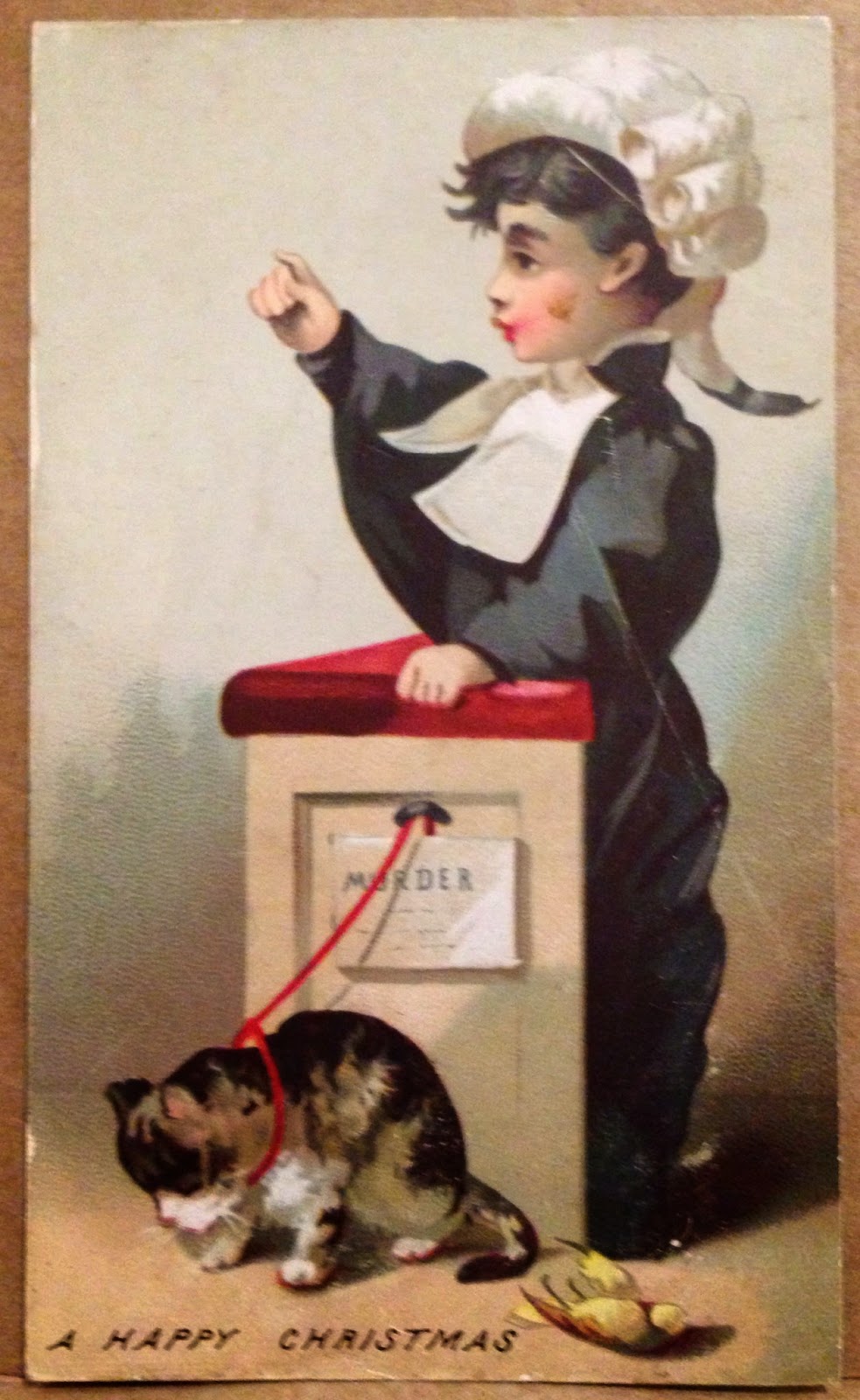
Happy Christmas from a child judge and murderous cat
The card shown here features a child dressed a judge, apparently trying a very guilty-looking cat with the crime of murdering a bird. I'm not sure where the "Happy Christmas" message comes in! Is the kitty getting a reprieve from the beneficent kid judge? Was the cat a menace and we're celebrating a holiday miracle that s/he can no longer terrorize the neighborhood? I don't know, but it's a wonderful little item. Best wishes for a wonderful holiday season!
Wednesday, December 11, 2013
Morris L. Cohen Student Essay Competition
The Legal History and Rare Books (LH&RB) Section of the American Association of Law Libraries, in cooperation with Cengage Learning, announces the Sixth Annual Morris L. Cohen Student Essay Competition. The competition is named in honor of Morris L. Cohen, late Professor Emeritus of Law at Yale Law School. Professor Cohen was a leading scholar in the fields of legal research, rare books, and historical bibliography.
The competition is designed to encourage scholarship, and to acquaint students with the American Association of Law Libraries and law librarianship. Essays may be on any topic related to legal history, rare law books, or legal archives. The competition is open to students currently enrolled in accredited graduate programs in library science, law, history, and related fields.
The entry form and instructions are available at the LH&RB
website: http://www.aallnet.org/sections/lhrb/awards. Entries must be submitted by 11:59 p.m.,
March 17, 2014.
The winner will receive a $500.00 prize from Cengage Learning and up to $1,000 for expenses associated with attendance at the AALL Annual Meeting. The runner-up will have the opportunity to publish the second-place essay in LH&RB's online scholarly journal "Unbound: An Annual Review of Legal History and Rare Books."
Wednesday, December 4, 2013
New acquisition: Bacon's Novum Organum Scientiarum
This is another exciting addition to our wonderful Francis Bacon collection, which is currently on exhibit. The Novum Organum was the centerpiece of Bacon's planned masterwork on science and philosophy, which he called the Instauratio Magna. In the Novum Organum, Bacon detailed his view that inductive reasoning is the best method for scientific inquiry. Professor Coquillette's gift included a first edition of this work; this new acquisition is the second edition, which was published in Latin (the first is in English) in Leiden in 1645. The title page features a ship boldly pushing past the Pillars of Hercules, a mythical symbol of the outermost bounds of knowledge. The Latin phrase beneath the picture translates (courtesy of Google Translate!) as "Go through and increase knowledge."
Subscribe to:
Posts (Atom)