Monday, November 26, 2018

Spotlight on the Exhibit: Heavily Annotated Burn's Justice

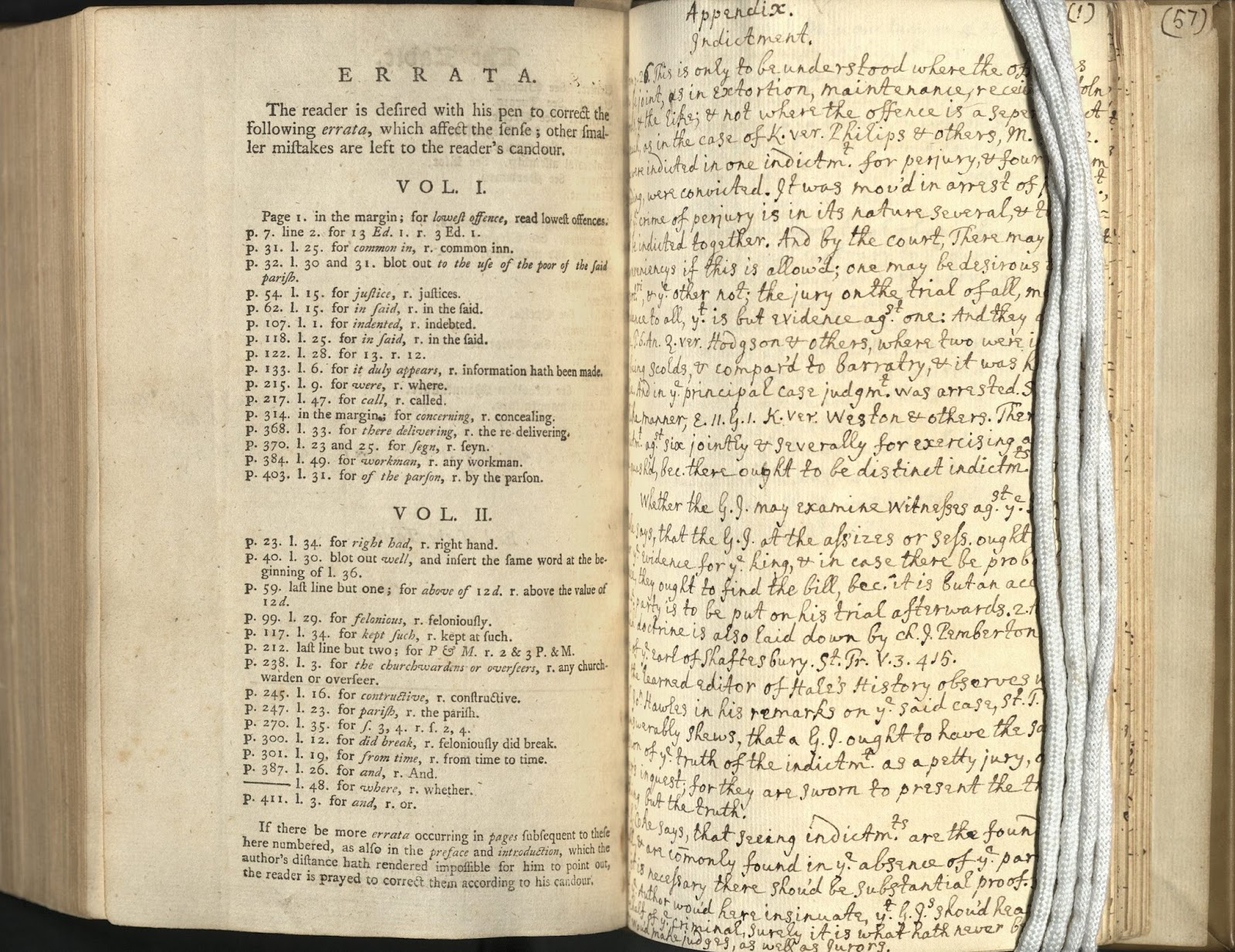
Marginal notes in burglary section of textDo you write in your books? Over 250 years ago, the owner of this copy of Richard Burn’s Justice of the Peace and Parish Officer (London, 1755) wrote in the margins—and bound in over 70 extra pages in the back for making more notes! Check out the annotations on the topic of "Burglary."

Manuscript annotations on added pages


Tuesday, September 18, 2018

New Exhibit in the Rare Book Room: Recent Additions to the Collection


Catalog cover for Recent Additions 2018 exhibit
We have a new exhibit on display in the Rare Book Room for the fall semester featuring additions to the collection over the past three years or so. Some highlights include: heavily annotated copies of important legal texts like Edward Coke's Reports and Richard Burn's Justice of the Peace and Parish Officer; a trial pamphlet for an 1859 Boston trial regarding the alleged assault and battery by a teacher upon a Roman Catholic pupil for his refusal to recite the Protestant version of the Ten Commandments; a statement of account from Daniel Webster's legal practice before he entered the world of politics; a writ from a lawsuit filed by James Otis Sr.; and perhaps most fascinatingly, a 1796 statement of account between a Sturbridge blacksmith and another individual in which a debit is listed for "one black man," against a credit for a sorrel horse--this would provide a unique lens through which a student could examine the legal status of people of color in the Commonwealth, even after the effective legal abolition of slavery in Massachusetts.

If you don't have a chance to visit the Rare Book Room (generally open weekdays from 9-5), please take a look at the exhibit webpage. This exhibit will remain on display into early 2019.

Tuesday, May 2, 2017

New acquisition: a 19th century law student outline?


Title page of the analysis
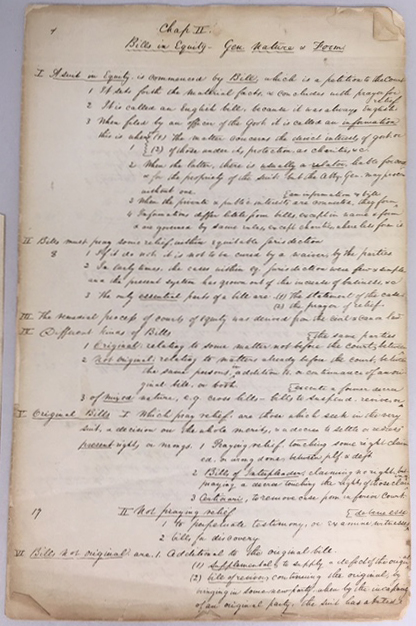
First page of the outlineWe loved this recent acquisition because it looks like a modern day law student outline! Following the structure of Joseph Story's Commentaries on Equity Pleadings (2nd ed, New York, 1940), the author created a detailed outline of Story's famous treatise, skipping only the short introductory chapter. Though the "title page" of the manuscript refers to the work as an analysis of Story's work, it really is simply a distillation of Story's main points, moving from chapter to chapter. The compiler often added references in the margins to the specific page of Story's work being summarized.

There is no identifying information about the compiler; the final page is dated March 10, 1842, and the paper, which features the Brittania watermark, has the embossed crest of the Owen & Hurlbut paper mill in Lee, Massachusetts. It seems likely that a Bay Stater--possibly a Harvard law student--compiled the outline. Indeed, Story assigned this text to his students during the 1842-1843 term (HLS catalogue for 1842-43 term, pages 11 and 13).

Our friends at the Lawbook Exchange, from whom we purchased this manuscript, wondered if the author (potentially a lawyer instead of a student) intended it to be published, as it is a fair copy with few corrections and to their eye, formatted for a typesetter. To me, it seems like an aid created by a student for his own study, particularly with the focus on distillation instead of analysis, but it will be interested to hear from others, as folks discover this manuscript.

Many thanks to Michael von der Linn at the Lawbook Exchange for his most helpful description.


Wednesday, April 19, 2017

New Acquisition: Personal Library Catalogue of Prominent Nineteenth-Century NYC Lawyer


page from Hawkin's catalog listed his law books Bound in beautiful Morocco, this catalogue highlights the intellectual pursuits of Dexter A. Hawkins, one of the founders of the preeminent New York City firm Hawkins Delafield & Wood LLP. Originally from New England, Hawkins opened up his practice at 10 Wall Street after reading law with Maine lawyer William Pitt Fessenden and completing his studies at Harvard Law School. The firm quickly expanded and became known for its specialty--governmental finance.

Hawkins detailed his impressive collection in meticulous script, organized by subject matter as laid out in an indexed table of contents. Notable titles from his law collection include:

  • Code Napoleon. Paris, 1809.
  • Vattel’s Law of Nations. Philadelphia, 1861.
  • Charters for City of New York, proposed by Committee of Seventy. 1872.
  • Webster's Speeches and Forensic Arguments. Boston, 1830.

His library enumerates several titles related to international law, as well as U.S. constitutional history and legal commentary. He also had a penchant for Greek, Roman, and American history, as well as illustrated works and texts on education, a subject for which Hawkins was famous as a promoter of free, nonsectarian public schools. Relatedly, Hawkins appears to be well-versed in foreign language, indicating volumes on the languages of Greek, French, Spanish, and German.

Sources: The Lawbook Exchange and website of Hawkins Delafield & Wood LLP

This post was written by Lauren Koster, BC Law Class of 2019. 

Wednesday, February 15, 2017

New exhibit on view--Robert Morris: Lawyer & Activist


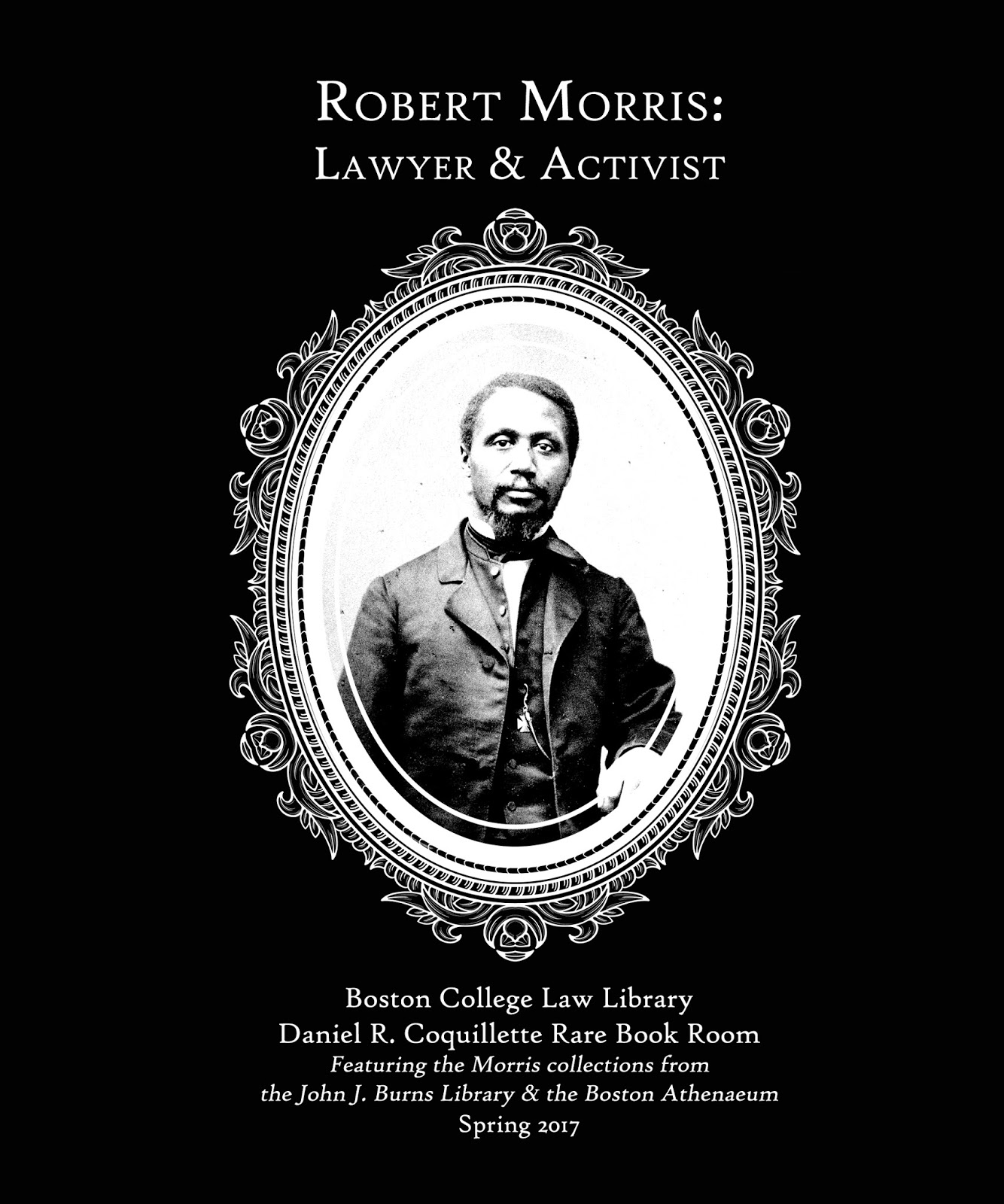
Cover of Robert Morris exhibit catalog We are pleased to announce the opening of the spring exhibit in the Law Library's Daniel R. Coquillette Rare Book Room. Curated by Mary Bilder and Laurel Davis, the exhibit is entitled "Robert Morris: Lawyer & Activist".

Morris (1823-1882), long known as one of the first African-American lawyers in the country, was a mover and shaker in Boston anti-slavery circles but also a full-throated civil rights activist in many other areas. He also had a fascinating relationship with Boston's Irish community and a very young Boston College.

All books in the exhibit belonged to Morris and are here on generous loan from Boston College's John J. Burns Library. Additionally, the Boston Athenaeum kindly loaned multiple items from their Robert Morris papers. Through his books and papers, we were able to explore Morris's many dimensions.

For a sneak peek, take a look at the online exhibit!

Wednesday, January 25, 2017

Morris L. Cohen Student Essay Competition

The Legal History and Rare Books (LH&RB) Section of the American Association of Law Libraries (AALL), in cooperation with Cengage Learning, announces the Ninth Annual Morris L. Cohen Student Essay Competition. The competition is named in honor of Morris L. Cohen, late Professor Emeritus of Law at Yale Law School.

The competition is designed to encourage scholarship and to acquaint students with the AALL and law librarianship, and is open to students currently enrolled in accredited graduate programs in library science, law, history, and related fields. Essays may be on any topic related to legal history, rare law books, or legal archives. The winner will receive a $500.00 prize from Cengage Learning and up to $1,000 for expenses to attend this year's AALL Annual Meeting in Austin, Texas.

Winning and runner-up entries will be invited to submit their entries to Unbound, the official journal of LH&RB. Past winning essays have gone on to be accepted by journals such as N.Y.U. Law Review, American Journal of Legal History, University of South Florida Law Review, William & Mary Journal of Women and the Law, Yale Journal of Law & the Humanities, and French Historical Review.

The entry form and instructions are available at the LH&RB website: www.aallnet.org/sections/lhrb/awards. Entries must be submitted by 11:59 p.m., April 17, 2017 (EDT).

Monday, January 9, 2017

New acquisition: 1613 edition of Justinian's Institutes

title page of justinian's institutes
The main focus of our collection is English and early American law books, but thanks to gifts by Professors Daniel R. Coquillette and Michael Hoeflich, we also have a strong collection of Roman law books. This new acquisition is a 1613 Venice edition of Justinian's Institutes, the synopsis of the Roman legal system that was designed to instruct law students. It's a key piece of the body of Roman law known as the Corpus Juris Civilis, organized and preserved by Emperor Justinian in the 6th century. 

text of justinian's institutes, with glossThis edition was edited and annotated by Silvestro Aldobrandini (1499 — 1558), a Florentine legal expert. It features red and black printing on the title page and woodcut initials throughout. As it typical in Roman law books, the original text is printed in the center, with the gloss (or commentary) and other annotations printed around it. 


Wednesday, October 19, 2016

New acquisition: heavily annotated volume of Coke's Reports

Along with his Institutes of the Laws of England, Sir Edward Coke's great contribution to English legal literature was his Law Reports. Ultimately printed in thirteen volumes, the Reports were not case reports in the way we now conceive of them, with the legal reasoning and final determination by the justice(s). Rather, the focus was on the pleadings-the back and forth between the lawyers and judge as the issues in the case were crystallized.

This new acquisition is the first edition of the eighth part of the Reports, published in London in 1611. It is in Law French and contains many well-known cases, including Dr. Bonham's Case, often referenced as a source of authority for judicial review of legislative acts. The book is lovely with its contemporary binding, wide margins, and beautiful printing. What makes it most interesting, however, are the extensive annotations. There are underlined passages, marginal notes, and portions of reports where the text is keyed to detailed commentary, allowing modern researchers to see how a contemporary reader engaged with the text.

Monday, September 26, 2016

Rare Book Room Traveling Show


Professor Bilder lecturing on various types of books
I was happy to have the opportunity to visit Professor Mary Bilder's American Legal History class this past Friday. Professor Bilder introduced her students to the various categories of legal literature (case reports, statutory compilations, justice of the peace manuals, legal treatises, law dictionaries, etc.) by showing examples from our Rare Book Room. After this introduction, each student received a book and had the chance to actually examine that book in detail. Using a worksheet with some prompts to guide their inquiry, students were asked to think critically about what the object itself can tell us about the book, its previous owners, and how it was used.

It's a great class every year, and this year was no different, with a great group of engaged and curious students. Many thanks to Professor Bilder for inviting us to class and for integrating rare books into her course!


Tuesday, September 6, 2016

New exhibit on the history of legal forms and formbooks

Exhibit catalog cover
I am happy to announce the opening of a new exhibit in the Daniel R. Coquillette Rare Book Room for the fall semester. The exhibit is called "Don't Reinvent the Wheel: The History of Forms in Anglo-American Literature". Whether in print sources, online databases, or law office knowledge management systems, good forms are a hugely important resource for litigators and transactional attorneys. Otherwise, every drafting project--complaints, motions, contracts, company documents--would involve starting from scratch!

This has been true for centuries--books with sample forms were among the first legal books to be transmitted via manuscript and later by printing. This exhibit takes a look at this long tradition from the earliest legal treatises to lawyers' personal manuscript books of precedents to pre-printed legal forms (known as "law blanks").

Please take a look at the exhibit webpage if you'd like a sneak peek. The room is open weekdays from 9:00 a.m. - 5:00 p.m., so please stop by to see the exhibit and say hello!

Friday, July 15, 2016

A look at the "crime of poverty" through a new acquisition

Title page and spine of Cutler's Insolvent Laws of Massachusetts
Our previous post shed light on the legal dilemma of debtors in the early United States. The book on hand today tracks the development of bankruptcy law in Massachusetts up to the eve of the Civil War.

This is the third edition of Joseph Cutler's The Insolvent Laws of Massachusetts (Boston, 1860), which includes relevant laws passed by the Massachusetts legislature through 1859. The fifth and final edition would be published in 1892. Few copies of any edition survive to the present day, and only ten third editions are known to exist. This particular copy, with its marbled covers and gilt fillets to the spine, belonged to W. S. Dexter, who wrote his name in pencil on the front flyleaf.

While the Greeks and Romans considered debtors’ prisons barbaric, the practice flourished in Europe and the English-speaking colonies of North America, beginning in the 1600s. For owing as little as 60 cents, even the rich and powerful, including two signers of the Declaration of Independence , might spend time in crowded communal cells. For the very poor, however, they might spend the rest of their lives imprisoned, unable to pay the debt and eventually felled by disease in the ghastly conditions of the gaol (The Marshall Project 2015).

By the time this book was published, the only writ that could be issued in relation to a debt was one allowing a sheriff to seize all of the debtor’s non-legally-excluded property for payment of the debt, as well as his account books (General Statutes, Ch. 118, Sec. 18, 1859). Federal law had banned debtors’ prisons in 1833, and in 1983 the Supreme Court would affirm their unconstitutionality. Despite this, since the Financial Crisis of 2008, the public has grown more and more aware of the practice of jailing poor people for being unable to pay debts. This occurs when private debtors fail to appear at civil proceedings and are jailed for contempt of court; jail can also be the result of debts incurred through involvement with the criminal justice system due to fines, a variety of evidence testing fees, or pretrial jail per-diems (The Marshall Project 2015).  While banned in law, it would appear debtors’ prisons live on in fact for unfortunate people whose only crime is being poor.

Thanks to the Lawbook Exchange, Ltd., for the background information on this item.

Sources:

Tuesday, June 28, 2016

Pay up or off to prison!

Promissory note and writ
This pair of documents recounts a trying period in the life of one Robert Taylor. The first, smaller piece of paper is a promissory note, signed on 18 February 1780, in Milton, Massachusetts. Taylor promises to deliver Isaac Davenport 300 “weight” of good merchantable flax by April 1 of the same year in exchange for £20.

The next document makes it clear that he did not deliver Davenport the flax. A forerunner of today’s fill-in- the-blanks legal forms, this is a writ, addressed to the sheriff of Worcester County, for the arrest of Taylor.

If the law caught up with Taylor, he would have been placed in debtors’ prison. Next week’s blog and selection from the Rare Book Room will examine the conditions Taylor would have faced in the prison, as well as a look at the history of debtors’ prisons in Massachusetts and the United States at large.

This post was written by BC Law Library intern, Allison Shely, Boston College Class of 2017. 

Thursday, June 16, 2016

"First" American edition of Vattel's seminal work on international law


Emer de Vattel's The Law of Nations, his seminal work on international law, was first published in 1758 in his native French. In 2014, we acquired this first edition in an original trade binding. Recently, we were happy to add a copy of a very early American edition to our collection. Indicated as the first edition on the title page, this is in fact the second American edition (the first was actually published in New York in 1787).

Vattel’s influential work was cited more frequently than any other work in the courts of the Early Republic and received high praise from the likes of Thomas Jefferson and Alexander Hamilton. It continues to be cited today by courts across our country and beyond.

This unassuming but lovely copy clearly was well-used; there are pencil markings throughout the volume. The binding is sheepskin patterned to mimic tree calf, with gilt tooling and the original lettering piece on the spine.

Many thanks to Michael von der Linn at Lawbook Exchange for the description on which this posted is based.

For more on the Vattel’s influence in colonial and early America, see Willem Theo Oosterveld, The Law of Nations in Early American Foreign Policy (Leiden, Boston: Brill, 2016), 26-35.

Wednesday, May 25, 2016

A Look Back at a Recent Student Event: Legally Binding


Last month, I hosted our second annual student lunch and "behind the scenes" Rare Book Room event. This year, we were lucky to have Barbara Hebard, Burns Conservator, as a special guest. We enjoyed a great lunch, and then went into the Rare Book Room with our six student attendees, a fantastic mix of enthusiastic first, second, and third year law students.

For each book, I gave a brief overview of the content and its importance in our collection, and then Barbara talked about the binding and other physical characteristics. I never fail to learn something when Barbara comes over. In addition to explaining what one can tell about a book and its audience by certain binding features, she pointed out evidence of long-removed clasps on our 1559 Corpus Iuris Civilis; revealed how our 1496 edition of the Decretales of Gregory IX had been bound in vellum over an earlier paper binding; and explained how you can tell how certain owners had clearly planned (or not, depending on the book!) for the addition of copious annotations.

The students, as usual, were amazed at the condition of the paper in our 1475 Nuremberg printing of the Code of Justinian. They had excellent questions about the process of dual-color printing, the relationship between printers and bookbinders, and the importance of annotations and other marginalia for legal historians.

At the end of our session, Barbara showed us all how to sew a pamphlet, and we used our current exhibit catalogs to practice!


Wednesday, April 13, 2016

Student Event in the Rare Book Room: Lunch, Books, and Binding

RSVP quickly to snag one of ten slots on OrgSync!

In light of the success of last year’s student event in the Rare Book Room, on Monday 4/25 at noon, curator Laurel Davis is going to host another lunch, exhibit, and discussion about our beautiful collection of rare books and manuscripts.

This year, we will have a special guest: Barbara Adams Hebard, Conservator at the Burns Library, the home of Boston College’s special collections. We will provide lunch from Panera in the law library conference room, and then move into the Rare Book Room to look at some highlights from our collection. After that, we’ll have a hands-on session with Barbara for those who would like to try their hand at binding a pamphlet!

Friday, February 26, 2016

Happy Leap Day and Year!

Apparently, there was an onslaught of Leap Year postcards in the early 20th century, particularly around 1908 and 1912. Most played on the idea that February 29th was a day in which women could take a leap, flip the old-fashioned tables, and propose to a man. The origins of the idea are murky, but perhaps are rooted in a 13th century Scottish law that supposedly penalized men for refusing a woman's proposal during a leap year.

Examples of these cards abound on the web, including a Leap Year postcard database from Monmouth University. Our own collection of legal postcards, gift of Michael H. Hoeflich and subject of a Fall 2014 exhibit, includes a legally-themed example. The woman is apparently on "the right side of the law" in proposing to the lawyer during a Leap Year.

Wednesday, February 24, 2016

Heavily Annotated First Edition of Burn's Justice of the Peace


Today’s featured acquisition is a first edition of Richard Burn’s The Justice of the Peace and Parish Officer. First published in 1755, Burn’s work is the most popular ever written on justices of the peace. This particular copy can provide researchers with great insights into how manuals like this were actually used. Our copy contains some 75 additional blank pages, most of which have been used as an appendix, adding cases and statutes under the headings from the book. There are also extensive marginal notes. Some are additions that the owner found useful to supplement the original text, while others are updates that refer to laws enacted after the time of publication. Some of the owner’s very legible notes can be seen in the photo above.
                                     
The extensive notes were presumably written by Richard Hopton of Canon-Frome, Hereford, whose bookplate appears in the front of both volumes. The Hopton family occupied a country house in the county of Herefordshire for centuries. Hopton himself was a lawyer in the area and would have been practicing at the time of publication. Worth mentioning is a schedule of fees for Herefordshire court officers, which is copied into the handwritten appendix in the first volume. 

Richard Burn was born in England in 1709. He attended school at Oxford, where he was later awarded a Doctor of Civil Law (D.C.L.). Burn went on to become justice of the peace for Westmorland and Cumberland counties. The Justice of the Peace and Parish Officer was his first book. What made the work particularly groundbreaking was its unique layout. Tired of the arbitrary organization that had plagued justices’ manuals in the past, Burn laid out a new plan in the preface of the first volume: “The author proposeth in this book to render the laws relating to the subjects it treats of, a little more intelligible than hath hitherto been done” (v). He was evidently successful. Even Blackstone praised Burn’s work, noting that it included “every thing relative to this subject, both in ancient and modern practice, collected with great care and accuracy, and disposed in a most clear and judicious method” (bk 1 c.9 iii [354 (1771)]). Burn went on to edit the ninth through eleventh editions of Blackstone’s Commentaries. The thirtieth and final edition of Justice was published in 1869, eighty-four years after Burn’s death.

Thanks to Joe Luttrell at Meyer Boswell Books for his helpful description.


Sources:
Norma Landau, “Burn, Richard (1709-1785),” Oxford Dictionary of National Biography, Oxford University Press, 2004.
The Hopton Family and Their Book-Plates,” Journal of the Ex Libris Society, 1904.

Thursday, January 21, 2016

Calling interested law students: annual essay competition is underway!


The eighth annual Morris L. Cohen Student Essay Competition is underway and open to any graduate student in law, library science, history, or related fields!

 The Legal History and Rare Books (LH&RB) Section of the American Association of Law Libraries (AALL), in cooperation with Cengage Learning, sponsors this annual competition, which is named in honor of Morris L. Cohen, late Professor Emeritus of Law at Yale Law School. The competition is designed to encourage scholarship and to acquaint students with the AALL and law librarianship, and is open to students currently enrolled in accredited graduate programs in library science, law, history, and related fields. Essays may be on any topic related to legal history, rare law books, or legal archives.

 The winner will receive a $500.00 prize from Cengage Learning and up to $1,000 for expenses to attend the AALL Annual Meeting in July in Chicago. The winner and runner-up will have the opportunity to publish their essays in LH&RB’s online scholarly journal Unbound: A Review of Legal History and Rare Books. The entry form, requirements, and instructions are available at the LH&RB website. Entries must be submitted by 11:59 p.m., April 18, 2016 (EST).

Monday, November 30, 2015

Early Maine Attorney's Court Docket Book

Today's item is a docket book once owned by Charles Greene, a successful lawyer in Maine. Interestingly, the entries begin in 1816, when Maine was still a district of Massachusetts. By the time of the last entry, in 1833, Maine had been a state for more than a decade. This book covers cases handled in the common law courts of York and Somerset Counties.

Charles Greene was educated at Dartmouth, from which he graduated in 1811. Upon graduating, he went to study law under his father, Judge Benjamin Greene, along with Dudley Hubbard, South Berwick's "first regularly educated lawyer." In 1814, just three years after graduating college, Charles Greene opened his own practice in South Berwick, York County. He would later move to Norridgewock before finally settling in Athens, where he would stay until his death in 1852. Greene continued to practice law and later became judge of the county probate court.

The book is completely filled in, with no blank pages and none missing. Overall, the volume contains 1569 cases. Most of the actions contained within are for debt, but several others of interest include actions of replevin, trespass, defamation, and dower, among others. The page shown above is part of Greene's comprehensive 12-page index. The index is split into two sections to separate Greene's time practicing in South Berwick from his practice in Athens.

Many thanks to Robert H. Rubin for the wonderful description on which this post is based.

Wednesday, October 14, 2015

New Acquisition: 19th Century Justice of the Peace Ledger

Wilkes Wood entry on theft
This acquisition is a manuscript ledger of cases heard by Wilkes Wood, a justice of the peace for Middleborough in Plymouth County, Massachusetts. Wood graduated from Brown University in 1793 and was admitted to the bar of Plymouth in 1796 after studying law there under Judge Thomas. He served as judge of probate and president of the Bar Association of Plymouth County. A member of the Whig Party, Wood served as a state senator for Massachusetts for two years and was a member of the electoral college that cast its vote for William Harrison.

Unlike today, justices of the peace in Massachusetts at the time had a good deal of power, with jurisdiction over criminal cases and some civil cases. Justices worked out of their own homes and kept their own records and ledgers. Dissatisfied parties could appeal the justices’ rulings to the local county courts, with the records for the appeal coming from the ledger or minute books of the justice of the peace who heard the original case. Catherine S. Menand, A Research Guide to the Massachusetts Courts and Their Records 60 (1987).

Wood’s ledger covers actions from 1801-1840, with the bulk of the entries from 1801-1816. Although most of them are related to defaults on debts, there are approximately one hundred actions brought for other matters including theft, assault and battery, and vagrancy. Additionally, there are several records of marriages performed by Wood. One of the more interesting actions is displayed above. In it, plaintiff Joseph Bisbe, a blacksmith, has brought an action against the defendant for theft. After examining the “proofs” offered, Justice of the Peace Wood declares the defendant to be guilty and orders him to pay a fine of three dollars as well as the costs of prosecution, listed on the bottom left of the page.

previous post showcased a similar record book belonging to a justice of the peace in Springfield.

Many thanks to Robert H. Rubin for the description on which this post is based.


Sources:
Thomas Weston, History of the Town of Middleboro Massachusetts (1906)
Catherine S. Menand, A Research Guide to the Massachusetts Courts and Their Records (1987)

This posted was drafted by BC Law Library intern, Liz Walk, Boston College Class of 2016.